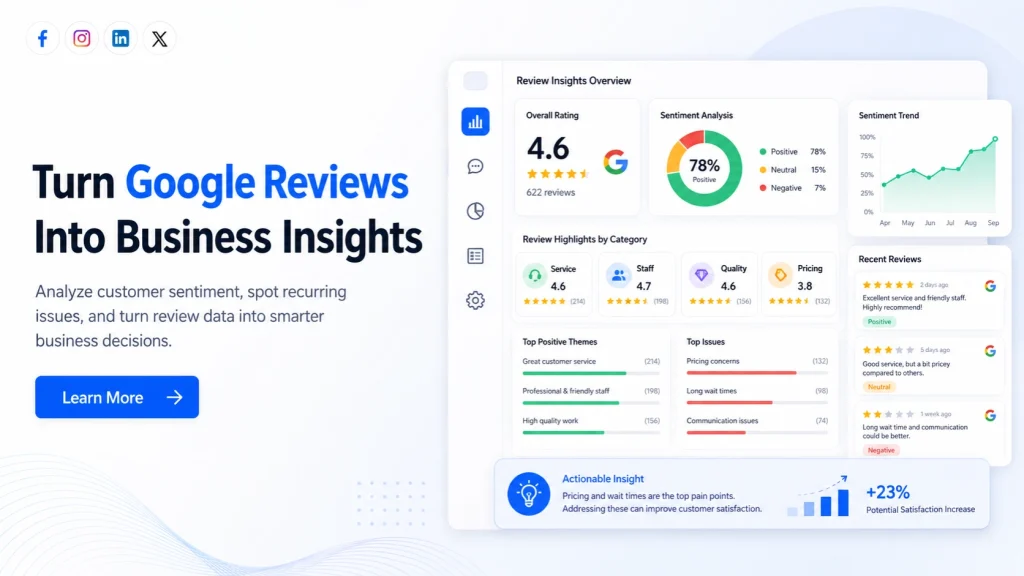
Google reviews contain much more than star ratings. Every review can reveal something about your customer experience, service quality, pricing, staff, operations, and even the reasons people choose your business.
The problem is that many businesses still read reviews one by one.
They reply to a customer, move to the next review, and rarely look at the bigger picture.
That means valuable customer data gets missed.
A better approach is to treat your reviews as a source of business intelligence.
The process is simple:
Reviews → Patterns → Priorities → Actions → Measurable Improvements
Here is how you can turn Google reviews into actionable business insights without making the process unnecessarily complicated.
Stop Reading Reviews One by One
A single review tells you what happened to one customer.
A group of similar reviews tells you what may be happening across your business.
For example, imagine one customer writes:
“The service was good, but I had to wait too long.”
That could be an isolated experience.
But if 15 customers mention long waiting times within a month, you are no longer looking at one complaint. You are looking at a possible operational issue.
This is where Google review analysis becomes useful.
Instead of asking only whether a review is positive or negative, look for five signals:
Sentiment: Is the customer positive, negative, neutral, or mixed?
Topic: What are they talking about staff, price, service, cleanliness, delivery, support, booking, or something else?
Frequency: How often is the same topic appearing?
Severity: How seriously does the issue affect the customer experience?
Recency: Is it an old problem, a continuing problem, or something that has started recently?
These five signals make it much easier to understand what your reviews are actually telling you.
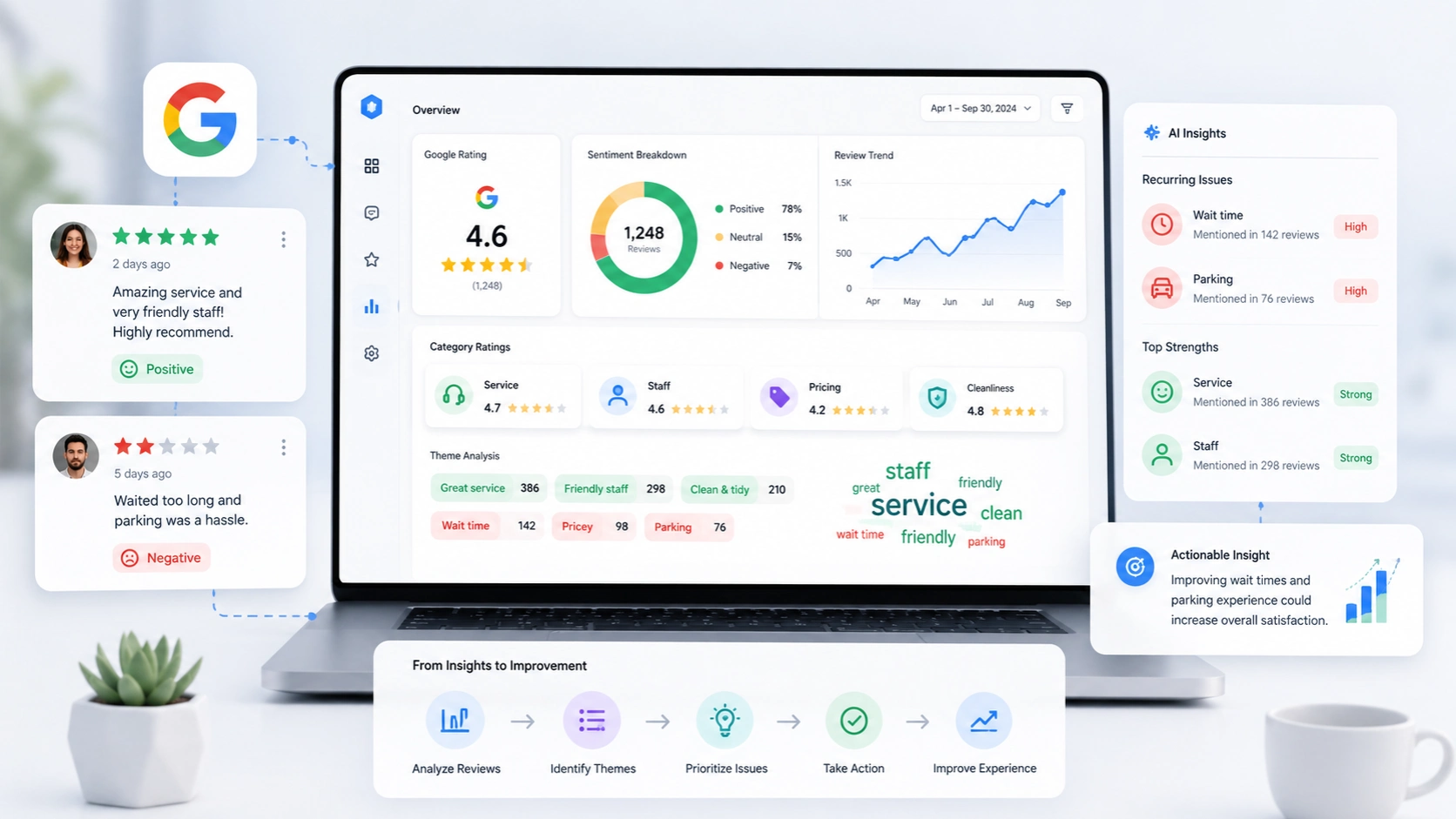
Group Reviews by Business Issue, Not Just Positive and Negative
One of the biggest mistakes in customer review analysis is dividing everything into two groups:
Positive reviews and negative reviews.
That is too broad.
Two negative reviews can describe completely different business problems.
A complaint about staff behaviour requires one type of action. A complaint about pricing requires another.
Instead, group reviews into practical business themes.
For example:
|
Review Theme |
What It May Reveal |
|
Waiting time |
Staffing or process problems |
|
Staff behaviour |
Training or service quality |
|
Pricing |
Value perception |
|
Product quality |
Delivery consistency |
|
Cleanliness |
Process or maintenance issues |
|
Booking experience |
Customer journey friction |
|
Availability |
Capacity or inventory problems |
|
Support |
Response-time or communication issues |
Once you organize reviews this way, customer feedback becomes easier to understand and much easier to act on.
Find Patterns That Actually Require Attention
Not every negative comment needs an immediate business change.
The important question is whether the problem is becoming a pattern.
Start by asking three questions.
Is the Same Issue Repeating?
If one person complains about waiting time, keep an eye on it.
If many customers mention waiting time, investigate it.
Repeated comments carry more weight because they show that different customers are experiencing a similar issue.
Is the Problem Increasing?
Frequency alone is not enough.
Look at when the comments appeared.
Suppose you received three complaints about slow service over six months, but eight similar complaints during the last four weeks.
That change matters.
It may indicate that something in your operations has recently changed.
This is why businesses should look at customer feedback trends, not only total review counts.
Does the Issue Affect the Buying Decision?
Some complaints have a much bigger business impact than others.
Problems involving service quality, trust, price, availability, delivery, cleanliness, or customer support may directly affect whether someone decides to buy from you.
Prioritize issues based on their effect on customers and the business, not simply because one reviewer sounds particularly unhappy.
Use Sentiment Analysis to Understand What Star Ratings Miss
Star ratings are useful, but they do not tell the entire story.
Consider this review:
“Excellent service and friendly staff, but we waited almost 40 minutes.”
A four-star rating may make this review appear positive.
But the text contains two very different insights.
Positive sentiment: Staff and service quality.
Negative sentiment: Waiting time.
If you classify the entire review as simply positive, you miss the problem.
This is why Google review sentiment analysis can provide deeper insight than star ratings alone.
The goal is to understand sentiment around specific parts of the customer experience.
For example:
- How do customers feel about your staff?
- Are customers becoming more negative about pricing?
- Is service quality getting better?
- Are complaints about delivery increasing?
- Which product or service receives the strongest praise?
Topic-level sentiment gives you a much clearer picture of business performance.
Prioritize Review Insights Before Taking Action
Finding problems is only the first step.
The next question is:
Which problem should we fix first?
A simple way to prioritize customer feedback is:
Priority = Frequency × Severity × Business Impact
Consider this example:
|
Review Insight |
Frequency |
Business Impact |
Priority |
|
Long waiting time |
High |
High |
Immediate |
|
Difficult booking process |
Medium |
High |
High |
|
Limited colour choice |
Medium |
Low |
Medium |
|
Parking complaint |
Low |
Medium |
Monitor |
This prevents your team from reacting randomly to every review.
A problem mentioned repeatedly by customers and directly affecting revenue, trust, or customer experience should usually receive more attention than a minor preference mentioned once.
In other words, do not fix the loudest complaint first.
Fix the most important recurring problem first.
Turn Every Important Insight Into a Business Action
An insight becomes valuable only when it leads to a decision.
A useful framework is:
Insight → Root Cause → Action → Owner → KPI
Here is what that looks like in practice:
|
Review Insight |
Possible Business Action |
KPI to Track |
|
Long waiting times |
Review peak-hour staffing |
Average waiting time |
|
Customers praise one employee repeatedly |
Identify and replicate successful service behaviour |
Service satisfaction |
|
Pricing complaints are increasing |
Review pricing or improve value communication |
Pricing sentiment |
|
Customers struggle with booking |
Simplify the booking process |
Booking completion rate |
|
Cleanliness complaints are recurring |
Introduce a daily quality checklist |
Cleanliness mentions |
|
Support response is slow |
Improve response workflow |
Average response time |
Now your Google reviews are no longer just comments.
They are helping guide operational decisions.
Positive Reviews Can Reveal Your Competitive Strengths
Businesses often focus so heavily on negative reviews that they overlook valuable information inside positive reviews.
Repeated praise can tell you what customers value most.
Look for patterns such as:
- fast response times
- helpful staff
- easy booking
- reliable service
- product quality
- convenience
- cleanliness
- personal attention
Suppose dozens of customers repeatedly praise your fast response time.
That may be one of your strongest competitive advantages.
The correct action is not simply to celebrate it.
You should protect it, standardize it, train your team around it, and potentially highlight it more strongly in your marketing.
Positive feedback tells you what should not be lost while you are improving other areas.
Compare Review Insights Over Time
Google review analysis should not be a one-time exercise.
Customer expectations change. Staff changes. Processes change. Competitors change.
Your review insights should therefore be compared across different periods.
For example:
Previous 30 days → Current 30 days
Track questions such as:
- Are negative mentions decreasing?
- Are recurring complaints disappearing?
- Has a new problem started appearing?
- Are customers mentioning a positive experience more frequently?
- Did a recent operational change improve customer sentiment?
Imagine waiting-time complaints drop from 18 mentions to four after you change staff scheduling.
That is useful evidence that the operational change may be working.
Your reviews now become a simple feedback loop:
Identify → Improve → Measure → Repeat
Know When Manual Review Analysis Stops Working
Manual review analysis can work when you receive only a few reviews.
But as review volume grows, the process becomes difficult.
You have to continuously:
monitor reviews → categorize feedback → identify sentiment → find recurring themes → compare trends → decide what requires attention
Doing all of this manually can take a significant amount of time, and important patterns can easily be missed.
This is where AI-powered review analysis becomes useful.
Instead of relying only on employees to read each review individually, businesses can use automation to organize and understand feedback at scale.
The purpose of AI should not be to replace business judgment.
It should help your team find the signals that deserve human attention faster.
Turn Review Data Into Insights With Visiblo AI
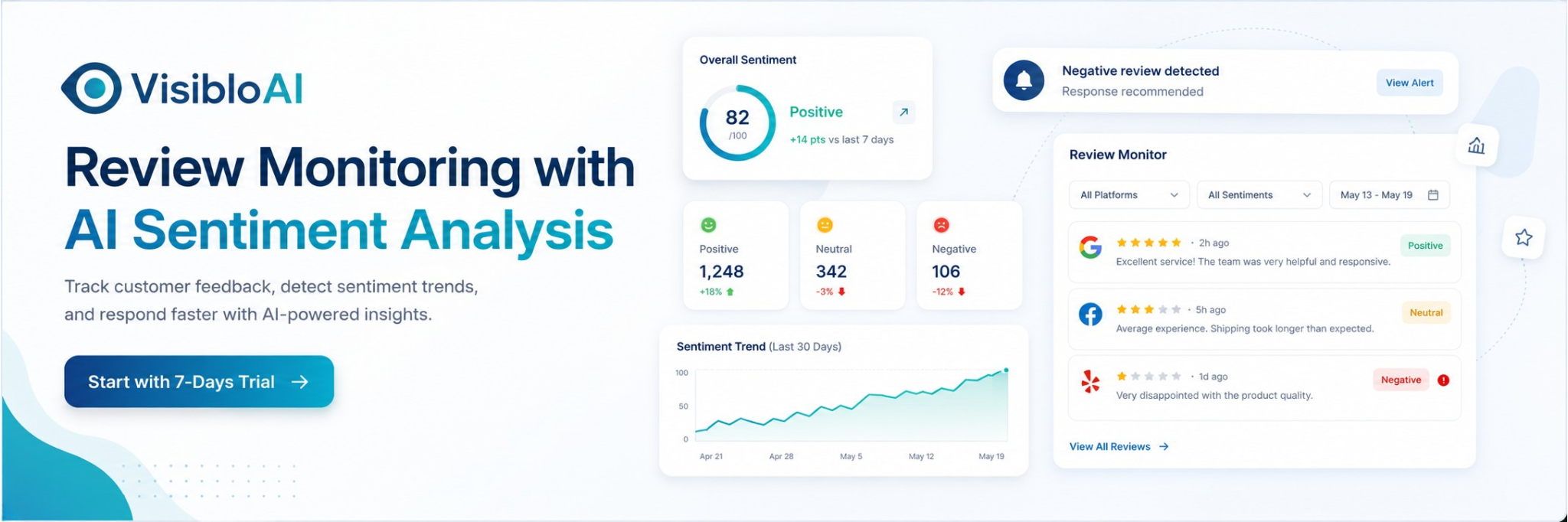
Visiblo AI is designed to help local businesses move beyond simply reading and replying to Google reviews.
With Review Monitoring and AI Sentiment Analysis, businesses can better understand what customers are saying, identify positive and negative sentiment, and monitor customer feedback without manually checking every review.
This makes it easier to spot recurring customer concerns and understand changes in customer sentiment over time.
Visiblo AI can also support businesses with AI-powered review replies, helping teams manage review activity more efficiently while still keeping customer communication active.
The goal is simple:
Spend less time manually reviewing feedback and more time acting on what customers are telling you.
Turn Your Google Reviews Into Business Insights
Use customer feedback to understand what is working, what needs attention, and where your next improvement should happen.
A Simple Review-to-Action Framework
You do not need a complicated analytics process to start using customer reviews more effectively.
Remember these six steps:
- Collect
Bring your recent Google reviews together. - Categorize
Group them by topics such as staff, service, pricing, quality, booking, or support. - Analyze
Look at sentiment, frequency, severity, and recency. - Prioritize
Focus on the recurring issues with the greatest customer and business impact. - Act
Turn the finding into a specific business improvement. - Measure
Monitor future reviews to see whether customer sentiment changes.
The most useful question is not:
“Are our Google reviews good or bad?”
Ask instead:
“What are customers repeatedly telling us, how much does it affect the business, what should we change, and how will we know whether the change worked?”
That is when Google reviews stop being simple customer comments and start becoming actionable business insights.
Frequently Asked Questions
How can businesses analyze Google reviews?
Start by grouping reviews into topics such as service, staff, pricing, quality, and support. Then examine sentiment, frequency, severity, and recency. Recurring issues with a high customer or business impact should receive the highest priority.
What business insights can Google reviews provide?
Google reviews can reveal customer pain points, service strengths, recurring complaints, operational issues, changing expectations, customer sentiment, and areas where the customer experience can be improved.
Can AI analyze Google review sentiment?
Yes. AI-based sentiment analysis can help classify feedback as positive, negative, neutral, or mixed and can make it easier to understand sentiment around specific topics within reviews.
How often should businesses analyze Google reviews?
Review analysis should be continuous. Businesses should regularly compare recent feedback with previous periods so they can identify emerging problems, monitor improvements, and understand changing customer expectations.