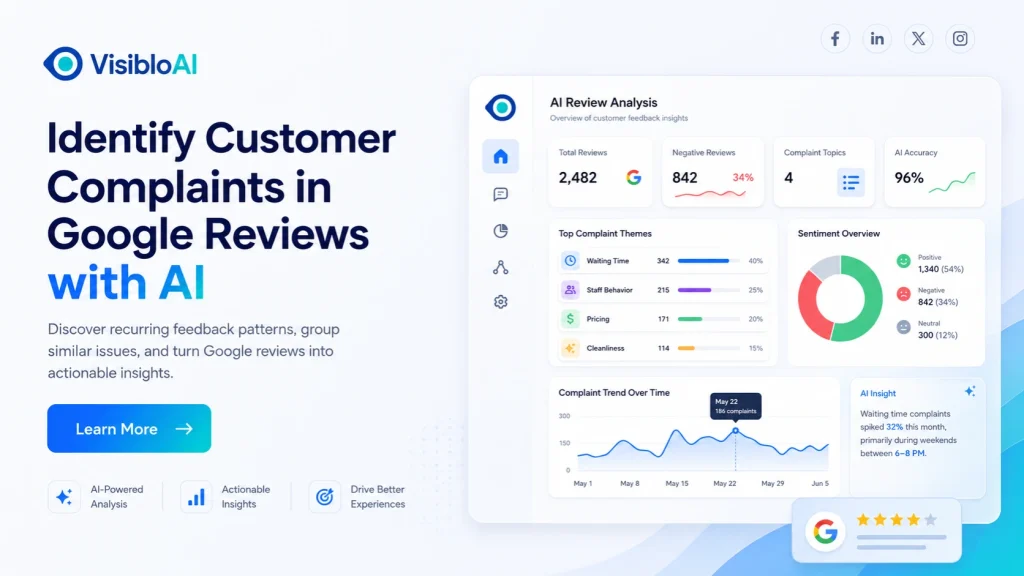
Google reviews can tell you much more than whether customers are happy or unhappy.
A business may have 50, 500, or even thousands of reviews, but manually reading every review does not always make it easy to answer important questions such as:
- What are customers complaining about most?
- Are different reviews describing the same problem?
- Is a particular complaint becoming more common?
- Which issues should the business fix first?
This is where AI Google review analysis becomes useful.
AI can analyze review text, understand the meaning behind customer comments, group similar complaints, identify recurring patterns, and turn scattered feedback into useful business insights.
Instead of simply knowing that customers are unhappy, you can understand what they are unhappy about, how frequently the problem occurs, and whether it is getting better or worse.
In this guide, we will explain how to analyze Google reviews with AI and use the results to identify common customer complaints faster.
What Does Identifying Common Customer Complaints Actually Mean?
Finding customer complaints does not simply mean looking at 1-star and 2-star Google reviews.
A customer complaint is usually connected to a specific part of the customer experience.
For example:
“The staff were friendly, but I waited almost 45 minutes before anyone attended to me.”
This review contains both positive and negative feedback.
The positive part is:
Staff behaviour → Positive
The complaint is:
Waiting time → Negative
If several customers mention similar experiences, the business may have a recurring waiting-time problem.
A useful customer complaint analysis should therefore answer four basic questions:
|
Question |
Example |
|
What happened? |
Customer waited too long |
|
What type of problem is it? |
Waiting time |
|
How often is it mentioned? |
32 reviews |
|
Is the problem increasing? |
Complaints increased this month |
This is much more valuable than simply counting negative reviews.
How AI Identifies Complaints Inside Google Reviews
Modern AI can analyze customer reviews using natural language processing, sentiment detection, topic identification, and semantic analysis.
In simple words, AI tries to understand what the customer actually means, rather than searching only for individual words.
Here is how the process usually works.
1. AI Understands the Meaning Behind the Review
Traditional keyword-based analysis can easily miss complaints.
Imagine four customers write:
“My delivery was late.”
“The order took forever to arrive.”
“I waited three days longer than expected.”
“Shipping was extremely slow.”
Only one review may contain the word late, but all four reviews are describing approximately the same problem:
Delivery delay
An AI review analysis system can understand this similarity because it looks at the meaning and context of the sentences.
This helps businesses identify complaints even when customers describe the same issue using completely different words.
2. AI Identifies the Specific Part of the Experience
One review can mention several parts of a customer experience.
Consider this example:
“The food was excellent, but we waited nearly an hour for our order.”
A basic sentiment analysis system might classify the review as mixed.
But that alone does not tell the restaurant what needs improvement.
A deeper analysis can separate the review into individual aspects:
Food quality → Positive
Waiting time → Negative
This type of analysis is often called aspect-based sentiment analysis.
It is especially useful because businesses do not only need to know whether a customer feels positive or negative.
They need to know:
What exactly caused that positive or negative experience?
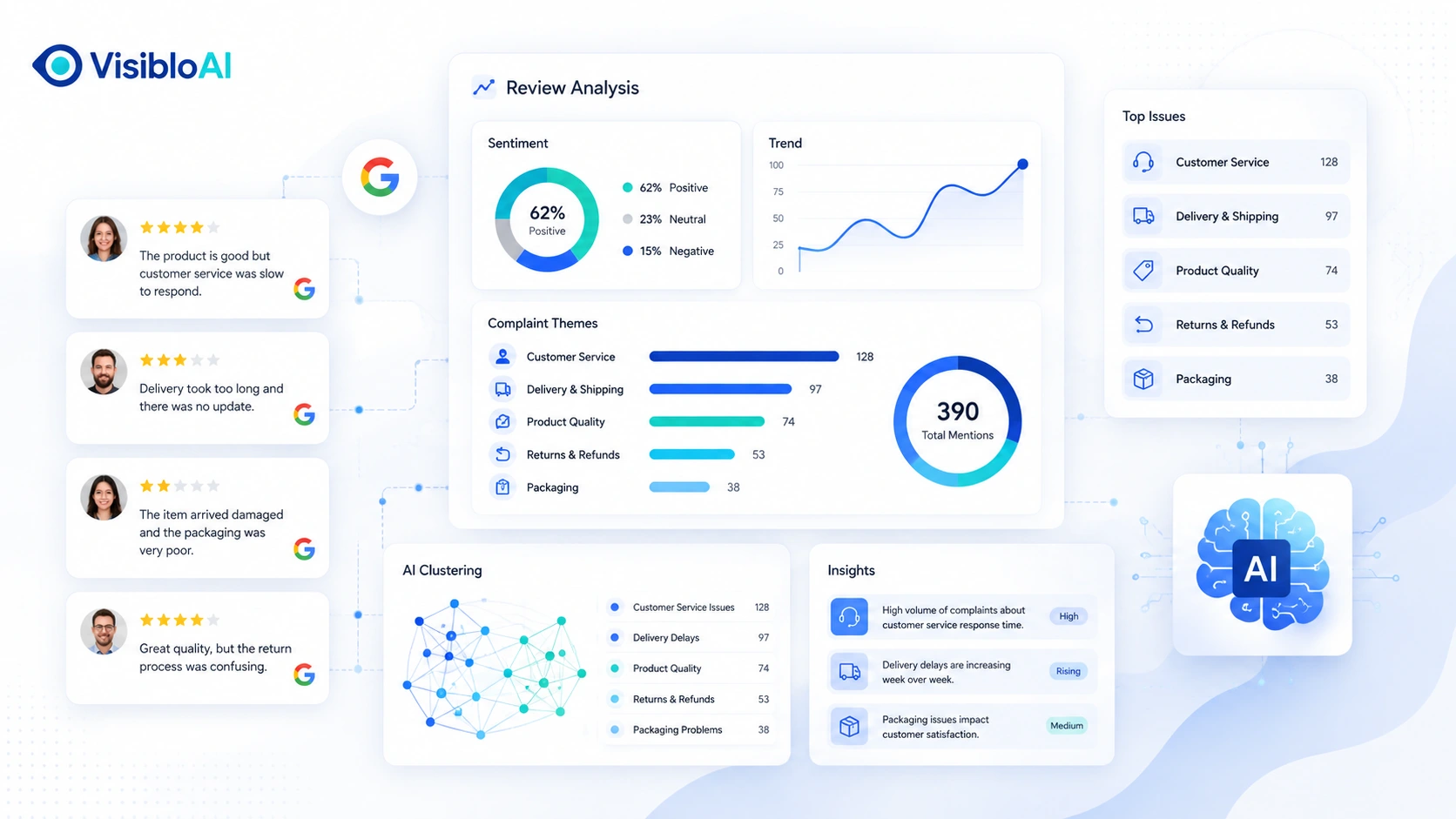
3. Similar Complaints Are Grouped Into Common Themes
Customers rarely describe the same problem using exactly the same words.
For example:
“The receptionist was rude.”
“Front desk staff were not helpful.”
“Poor behaviour at reception.”
“The receptionist spoke badly to us.”
These reviews may all be grouped under a broader complaint category such as:
Front Desk / Staff Behaviour
This process is sometimes called topic clustering, theme clustering, or semantic grouping.
Instead of seeing four separate complaints, the business can identify one recurring issue affecting several customers.
This makes review data much easier to understand.
4. AI Measures How Frequently Each Complaint Appears
Once similar complaints are grouped together, businesses can measure how often each problem is mentioned.
For example:
|
Complaint Category |
Mentions |
Share of Complaint Reviews |
|
Long waiting time |
42 |
31% |
|
Staff behaviour |
28 |
21% |
|
Pricing concerns |
19 |
14% |
|
Cleanliness |
13 |
10% |
|
Booking problems |
9 |
7% |
This immediately gives the business a clearer picture of where customers are experiencing problems.
However, frequency alone should not decide what gets fixed first.
How to Find the Customer Complaints That Need Attention First
One of the biggest mistakes businesses can make is assuming that the most frequently mentioned complaint is automatically the most important one.
A better approach is to evaluate complaints using several factors.
Complaint Frequency
Ask:
How often are customers mentioning this problem?
If 30 different customers mention long waiting times, it is more likely to represent a recurring operational issue than a single isolated complaint.
Frequency helps businesses understand the scale of the problem.
Complaint Severity
Not every complaint has the same impact.
Compare these examples:
“Parking was a little difficult.”
and
“I was charged twice for the same order.”
Both are complaints, but the second issue is clearly more serious.
AI can help businesses identify stronger negative language and highlight potentially severe customer experiences.
Human review is still important when the issue is serious.
Complaint Trend
Businesses should also ask:
Is the complaint becoming more common over time?
Imagine waiting-time complaints look like this:
April: 5 mentions
May: 7 mentions
June: 12 mentions
July: 21 mentions
The total number may still be lower than another complaint category, but the upward trend suggests that something is changing.
This makes trend analysis extremely useful for identifying problems before they become much larger.
Business Impact
Some complaints directly affect purchasing decisions, repeat business, bookings, customer trust, or reputation.
For example, a hotel may receive complaints about:
- Slow Wi-Fi
- Difficult parking
- Room cleanliness
Parking may receive the most mentions.
But if cleanliness complaints are strongly negative and directly influence bookings, cleanliness may need to be addressed first.
This is why businesses should combine review data with business context.
A Simple Framework for Prioritizing Google Review Complaints
A practical way to evaluate customer complaints is to use four factors:
Frequency × Severity × Trend × Business Impact
Frequency: How often does the problem appear?
Severity: How strongly does the issue affect customers?
Trend: Is the problem increasing or decreasing?
Business Impact: Could the issue affect revenue, customer trust, retention, bookings, or operations?
For example, imagine a restaurant identifies:
|
Complaint |
Mentions |
|
Parking difficulty |
55 |
|
Slow service |
42 |
|
Incorrect orders |
21 |
Parking has the highest number of mentions.
However, incorrect orders may cause stronger customer frustration, refunds, and negative reviews.
Therefore:
The most common complaint is not always the highest-priority complaint.
This is why AI insights should support business decisions rather than replace judgment.
AI Can Find Complaints Hidden Inside Positive Google Reviews
Businesses often analyze only 1-star and 2-star reviews when looking for customer problems.
That can be a mistake.
A positive review can still contain useful criticism.
For example:
“Excellent doctor and very helpful nurses. I would definitely recommend the clinic. The only problem was that my appointment started almost an hour late.”
The customer may still leave a 5-star review.
But there is a clear operational complaint:
Appointment delay
If several positive reviews mention the same issue, the business has identified an improvement opportunity before it starts causing more serious dissatisfaction.
This is why effective Google review analysis should examine review text across all star ratings.
Important Insight
Do not analyze only negative ratings. Analyze the actual review text.
Star ratings show the overall experience.
Review text explains why the customer felt that way.
How to Separate One-Off Complaints From Recurring Business Problems
Not every complaint means the business needs to change its operations.
Some issues may be isolated incidents.
To identify a real pattern, look for three signals.
Repetition
Are unrelated customers mentioning similar problems?
One customer reporting a long wait may be an isolated situation.
Twenty customers mentioning long waiting times is a pattern worth investigating.
Time Consistency
Does the complaint continue appearing over several weeks or months?
If the same problem keeps returning, it may indicate a deeper operational issue.
Location, Service, or Team Concentration
Multi-location businesses should avoid looking only at total complaint numbers.
For example:
Location A: Long waiting times
Location B: Parking complaints
Location C: Staff behaviour complaints
The company does not have one single customer experience problem.
It has different problems at different locations.
AI-based review analysis can make these patterns easier to identify when reviews are categorized correctly.
What Customer Complaint Categories Should Businesses Track?
Complaint categories depend on the type of business, but common areas include:
|
Business Area |
Typical Customer Complaints |
|
Service |
Slow service, delays, communication issues |
|
Staff |
Rude behaviour, lack of support, poor knowledge |
|
Product |
Quality problems, defects, availability |
|
Pricing |
Unexpected charges, high prices, unclear fees |
|
Operations |
Waiting time, scheduling, delivery delays |
|
Facility |
Cleanliness, parking, accessibility |
|
Support |
Slow resolution, unanswered calls |
|
Digital Experience |
Website, app, booking, or payment issues |
The important point is that businesses should not force every review into generic categories.
A clinic, restaurant, software company, service apartment, and retail store will all have different customer journeys.
Complaint categories should reflect the actual business experience.
Examples of Complaints AI Can Identify Across Different Industries
The same AI review analysis process can be useful across many industries.
Restaurants
AI may identify recurring complaints related to:
- Waiting time
- Food temperature
- Order accuracy
- Staff behaviour
- Cleanliness
- Delivery delays
Hotels and Service Apartments
Common patterns may include:
- Room cleanliness
- Check-in delays
- Wi-Fi quality
- Staff responsiveness
- Amenities
- Booking communication
Clinics and Healthcare Businesses
Review analysis may highlight:
- Appointment waiting time
- Reception experience
- Staff communication
- Billing concerns
- Scheduling problems
Retail Stores
AI may identify complaints related to:
- Product availability
- Checkout delays
- Staff support
- Returns
- Pricing
- Product quality
The categories change, but the process remains similar:
Read → Identify → Group → Measure → Prioritize → Act
Turning Google Review Complaints Into Actionable Business Insights
Finding complaints is only useful when the business does something with the information.
A simple improvement workflow could look like this:
Step 1: Detect the Complaint
Customers repeatedly mention:
Slow customer support response
Step 2: Validate the Pattern
Check:
- How many reviews mention it?
- When did the complaints appear?
- Which locations or services are affected?
- How strong is the negative sentiment?
- Are the reviews describing the same underlying problem?
Step 3: Investigate the Cause
Possible causes could include:
- Not enough support staff
- Poor ticket routing
- Peak-hour demand
- Slow internal approval
- Lack of employee training
Step 4: Take Corrective Action
The company may improve staffing, change workflows, update training, or communicate expected response times more clearly.
Step 5: Continue Monitoring Reviews
After the change, continue tracking the same complaint category.
If mentions fall over time, the improvement may be working.
This creates a useful feedback loop:
Customer Review → Insight → Business Action → New Customer Feedback
That is where customer review analysis becomes genuinely valuable.
How Visiblo AI Can Make Google Review Analysis Easier
For a business receiving only a few reviews, manual review analysis may still be manageable.
But as review volume grows, manually checking every review, identifying themes, monitoring sentiment, and responding consistently becomes difficult.
This is where a platform such as Visiblo AI can help simplify the wider Google Business Profile workflow.
Visiblo AI is designed to help businesses automate and manage important Google Business Profile and Local SEO activities from one platform.
Monitor Google Reviews More Efficiently
Instead of repeatedly checking business profiles manually, businesses can keep track of customer feedback more consistently.
This makes it easier to notice new complaints and changing customer sentiment.
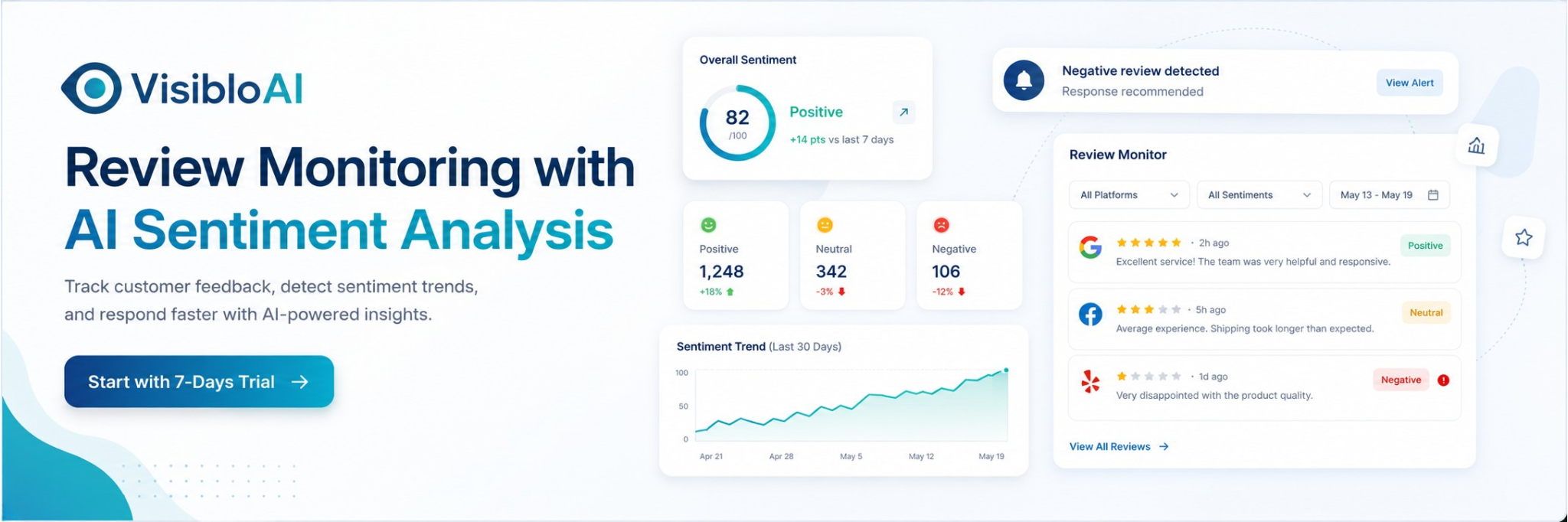
Understand Review Sentiment With AI
AI sentiment analysis can help businesses understand whether customer feedback is positive, negative, neutral, or mixed.
This provides a faster way to discover reviews that may require closer attention.
Identify Useful Customer Feedback Patterns
When review data is analyzed together, businesses can better understand recurring customer concerns rather than treating each review as an isolated comment.
This helps teams move from simply reading reviews to learning from them.
Respond to Reviews Faster
Review management is not only about analysis.
Customers also expect businesses to acknowledge their feedback.
AI-assisted review workflows can help teams prepare relevant responses faster while still allowing businesses to maintain human oversight.
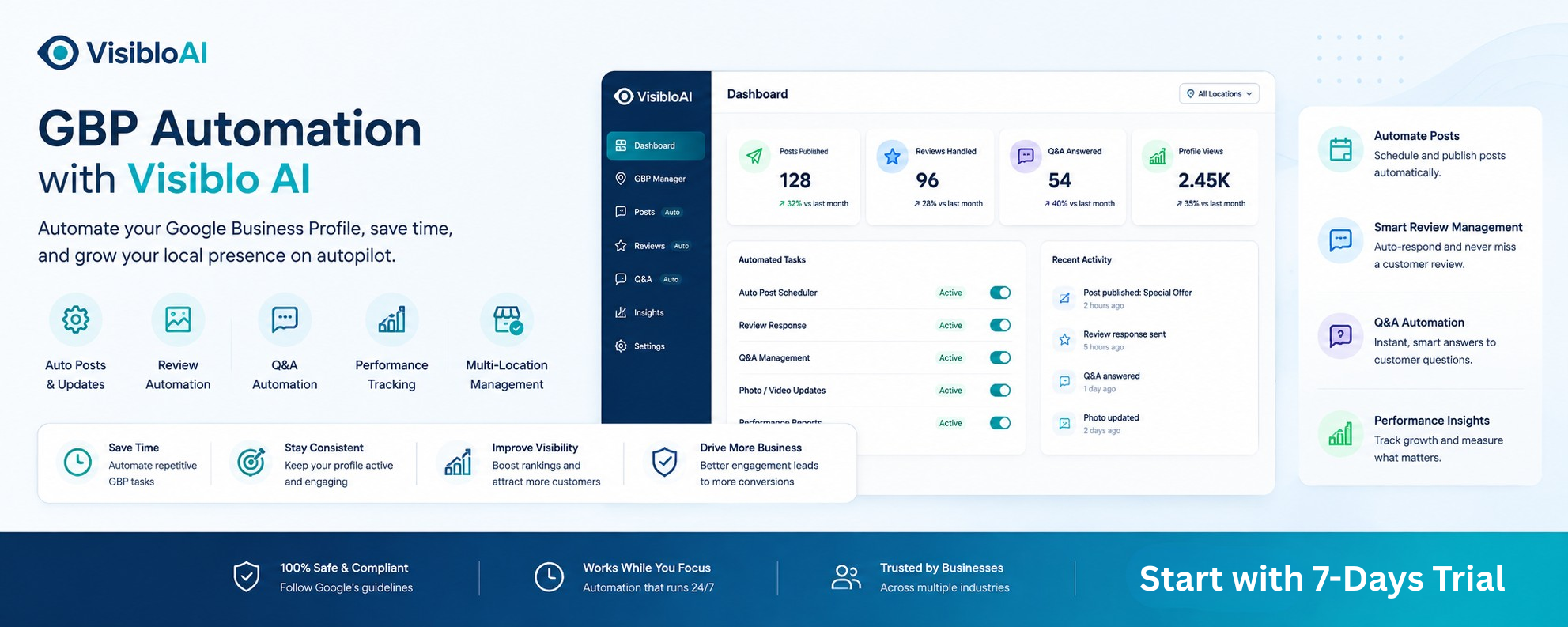
Connect Review Management With Google Business Profile Automation
Customer reviews are only one part of local visibility.
Businesses also need to manage Google Business Profile posts, media, reputation, rankings, and other Local SEO activities.
Visiblo AI helps bring these activities into a more organized workflow so businesses can spend less time on repetitive tasks and more time improving the customer experience.
The goal is not simply to identify a complaint.
The goal is to understand customer feedback, respond appropriately, improve operations, and continuously strengthen the business’s Google presence.
What AI Should Not Decide Without Human Review
AI can make review analysis significantly faster, but businesses should not assume that every AI-generated insight is automatically correct.
There are several situations where human review remains important.
Sarcasm
A customer might write:
“Amazing service. Only had to wait 90 minutes.”
The words may appear positive, but the meaning is clearly negative.
Advanced AI can often detect this, but sarcasm can still be difficult.
Mixed Sentiment
One review can contain multiple experiences.
“Great food, rude staff, beautiful location.”
The review should not simply be labeled positive or negative.
Each aspect needs to be understood separately.
Industry-Specific Language
Words can have different meanings across healthcare, finance, hospitality, software, and other industries.
Business context matters.
Serious Customer Allegations
If a review contains serious claims involving safety, fraud, discrimination, legal matters, or other sensitive issues, businesses should review the original feedback carefully before taking action.
Small Sample Sizes
Three complaints do not necessarily prove that a business has a major operational problem.
Look at frequency, time period, context, and total review volume.
Incorrect Grouping
Two complaints may sound similar but have different root causes.
For example:
“Delivery was late.”
and
“Staff took too long to prepare the order.”
Both involve delays, but one relates to logistics while the other relates to internal operations.
Best Approach
Use AI to discover patterns faster. Use human judgment to understand causes and decide what needs to change.
How Often Should Businesses Analyze Google Reviews?
There is no single schedule that works for every business.
The right frequency depends on review volume, number of locations, industry, and customer experience risk.
Low Review Volume
A small local business receiving only a few reviews each month may find monthly analysis sufficient.
Growing Local Business
Weekly or bi-weekly monitoring can help identify new issues before they become recurring patterns.
High-Volume or Multi-Location Business
Continuous review monitoring can be more useful because complaint patterns may change quickly across locations.
The important thing is consistency.
A business should not wait until ratings fall significantly before trying to understand what customers are saying.
Quick Checklist: How to Identify Common Customer Complaints With AI
If you want a simple process, follow these steps:
- Collect Google review text from the period you want to analyze.
- Analyze reviews across all star ratings.
- Identify the specific products, services, or experiences customers mention.
- Detect positive, negative, neutral, and mixed sentiment.
- Group similar complaints into common themes.
- Measure how often each complaint appears.
- Compare complaint trends across different periods.
- Check severity and potential business impact.
- Compare results by location, service, or team where relevant.
- Review the original comments before making major decisions.
- Take corrective action.
- Continue monitoring whether the complaint decreases over time.
This process transforms Google reviews from simple customer comments into useful business intelligence.
Frequently Asked Questions
Q1. Can AI Analyze Google Reviews Automatically?
Yes. AI can analyze large amounts of review text much faster than a person reading every review manually. It can help detect sentiment, identify themes, group similar customer complaints, and highlight recurring feedback patterns. Businesses should still review important findings before making major decisions.
Q2. Can AI Identify Complaints in Positive Google Reviews?
Yes. A positive review can still contain criticism. For example, a customer may praise the service but mention a long waiting time. AI can analyze individual parts of the review instead of relying only on the overall star rating.
Q3. How Does AI Group Similar Customer Complaints?
AI can compare the meaning of different sentences and identify comments that describe similar experiences. Phrases such as “slow delivery,” “order arrived late,” and “shipping took too long” can be grouped into a single complaint category such as delivery delay.
Q4. What Is the Difference Between Sentiment Analysis and Complaint Analysis?
Sentiment analysis identifies how a customer feels, such as positive, negative, neutral, or mixed. Complaint analysis goes further by identifying what caused the negative experience. For example, sentiment may be negative, while the actual complaint may be waiting time, pricing, staff behaviour, or product quality.
Q5. How Can I Find Recurring Problems in Google Reviews?
Analyze reviews over a meaningful period, group similar feedback into complaint categories, measure how frequently each category appears, and compare the results over time. Repeated complaints from different customers are stronger indicators of an underlying business problem.
Q6. Which Customer Complaints Should a Business Fix First?
Look beyond frequency. Consider the frequency, severity, trend, and business impact of each complaint. A less common issue may still require immediate attention if it significantly affects customer trust, safety, revenue, or service quality.
Q7. Can AI Completely Replace Manual Review Analysis?
No. AI is highly useful for processing large amounts of feedback and identifying patterns quickly, but human judgment remains important. Businesses should review original comments, investigate root causes, and use operational context before making important decisions.
Turn Google Reviews Into Insights You Can Act On
Google reviews contain much more information than star ratings.
When businesses analyze the actual words customers use, they can discover recurring complaints, hidden pain points, changing customer expectations, and operational problems that may otherwise go unnoticed.
AI makes this process faster by helping businesses understand review context, identify specific complaint areas, group similar feedback, measure frequency, and recognize patterns over time.
But identifying a problem is only the first step.
The real value comes from turning those insights into action, improving the customer experience, and continuing to monitor whether the changes are working.
Visiblo AI helps businesses simplify Google Business Profile management by bringing together review monitoring, AI-powered review insights, faster review workflows, Google Business Profile automation, and Local SEO support.
Instead of manually managing every activity, businesses can build a more consistent process for understanding customers and improving their local online presence.
Ready to turn customer reviews into useful business insights?