

For most local businesses, posting on Google Business Profile 1-2 times per week is a practical starting point. Businesses that regularly run offers, events, product updates or time-sensitive promotions may benefit from 2–3 posts per week, while businesses with fewer updates may get more value from one useful post each week.
The important point is that there is no single posting frequency that works for every business. Google explains how Business Profile posts work, but it does not prescribe an ideal number of posts per week. Your schedule should depend on how often you have something useful, relevant and timely to share with potential customers.
Instead of asking, “How many posts should we publish?”, a better question is:
“How often do our customers have a good reason to hear from us?”
That is the approach we will use throughout this guide.
How Many Google Business Profile Posts Should You Publish Per Week?
Here is a practical starting point for most businesses:
|
Business Situation |
Recommended Starting Frequency |
|
Most local businesses |
1–2 posts per week |
|
Businesses with regular promotions |
2–3 posts per week |
|
Restaurants and active retail stores |
2–4 posts per week when relevant |
|
Clinics and professional services |
1–2 posts per week |
|
Businesses with few new updates |
1 useful post per week |
|
Multi-location businesses |
1–2 relevant posts per location per week |
|
Events or temporary campaigns |
Increase frequency when required |
These numbers should be treated as a working framework, not a Google ranking formula.
Publishing four weak posts simply because your calendar says you need four posts is unlikely to be more useful than publishing one strong post that answers a customer question, promotes a genuine offer or communicates an important update.
The goal is not maximum posting.
The goal is consistent, useful communication.

There Is No Universal Best Google Business Profile Posting Frequency
The ideal Google Business Profile posting frequency depends heavily on the type of business.
Consider a restaurant.
It may have a new weekend menu, weekday lunch offer, special event and seasonal dish within the same week. Three useful posts during that week could make complete sense.
Now consider a chartered accountant.
That business may not have three meaningful updates every week. One useful post explaining a tax deadline, service or common client question may offer much more value than several repetitive promotional posts.
This is why posting frequency should follow a simple sequence:
Business activity → customer need → useful information → GBP post
Not:
Posting target → filler content → publish
If your business genuinely has more valuable information to communicate, increase your posting frequency. If it does not, maintaining quality is more important than filling every empty space in a content calendar.
How Often Should Different Types of Businesses Post?
Different industries operate at different speeds. Your posting schedule should reflect that.
Restaurants and Cafes
Restaurants can usually support a higher posting frequency because offers, menus and customer decisions change quickly.
A restaurant could start with 2–4 posts per week, depending on how active the business is.
Useful posts may include lunch specials, new dishes, weekend offers, events, festive menus or changes to operating hours.
That does not mean every restaurant should post every day. Daily posting only makes sense when there is something genuinely useful to communicate.
Salons and Spas
For salons, spas and beauty businesses, 1–3 posts per week is often a sensible starting point.
Posts can focus on available treatments, service education, seasonal services, special packages or appointment-related promotions.
If you are repeating the same treatment and discount every day with slightly different wording, reducing the frequency may improve the overall quality of your profile content.
Clinics and Healthcare Practices
Clinics, dentists and other healthcare businesses usually do not need aggressive posting schedules.
Starting with 1–2 useful posts per week gives you room to share service information, patient education, important announcements and common questions without turning the profile into a constant promotional feed.
The emphasis should remain on usefulness and clarity.
Retail Stores
Retail businesses often have more reasons to post because stock, offers and seasonal demand can change frequently.
A starting point of 2–3 posts per week may work well when you regularly have new arrivals, limited-time deals, product collections or seasonal promotions.
During quieter periods, you can reduce the frequency.
Professional Service Businesses
Law firms, accountants, consultants, agencies, software companies and similar businesses can generally begin with 1–2 posts per week.
For these businesses, educational posts and clear service information usually make more sense than frequent promotional posts.
A useful answer to a common customer question can often be more valuable than another generic “contact us today” post.
Real Estate Businesses
Real estate businesses may start with 1–3 posts per week, depending on listing activity.
Property launches, project updates, new listings, location information and market-related updates can all provide good reasons to publish.
When listing activity increases, your posting frequency can increase with it.
Multi-Location Businesses
For multi-location businesses, frequency is only one part of the challenge.
A reasonable starting point may still be 1–2 posts per location per week, but relevance becomes particularly important.
Avoid copying the exact same generic post across dozens of locations whenever you can provide something more useful locally.
Different branches may have different offers, services, events, timings or customer needs. Your Google Business Profile content should reflect those differences.
Should You Post on Google Business Profile Every Day?
For most businesses, daily posting is not necessary.
There is nothing wrong with publishing frequently when your business has enough meaningful content. A busy restaurant, event venue or retailer may occasionally have valid reasons to post every day.
But daily posting should not become an SEO task that exists only to keep the profile “active.”
If your daily schedule starts producing almost identical posts, repetitive offers or weak content, you are probably posting too often.
A simple rule can help:
Increase your posting frequency because your business has more useful information not because you think Google requires another post.
Google’s published local-ranking guidance focuses mainly on relevance, distance and prominence. It does not state that businesses need to publish a particular number of GBP posts per day or week to rank locally.
Is One Google Business Profile Post Per Week Enough?
For many businesses, yes.
One strong post per week can be a perfectly reasonable schedule when your business does not generate frequent changes or promotions.
Suppose you run a consulting firm. You may publish one helpful post each week covering a service, common question, business update or customer problem.
There is no need to increase that to five posts simply to hit an arbitrary number.
One post per week becomes less suitable when customers regularly need new information.
For example, a restaurant running different weekday offers or a store launching several promotions may need a more active schedule.
The correct question is therefore not whether one post per week is universally “enough.”
It is whether one post per week is enough to communicate what currently matters to your customers.
Your Posting Frequency Should Change With the Type of Post
Google currently supports three main Business Profile post types: Updates, Offers and Events. Offers and events can contain date ranges, while regular updates can be used for broader business information.
You do not need to publish each type equally.
Regular updates can form the base of your weekly schedule.
Offers should be published when you actually have a promotion worth communicating.
Events should follow the dates and timing of real events.
Seasonal content should increase when a relevant season, holiday or business period approaches.
The mistake is creating a promotion simply because the content calendar says, “Tuesday = Offer Post.”
Your calendar should support your business activity, not create artificial activity.
What Should Determine Your Google Business Profile Posting Frequency?
Several practical factors should influence your schedule.
The first is how often your business changes. A company with frequently changing stock, offers or events naturally has more reasons to post.
The second is how often customers make decisions. Someone may choose a restaurant several times in one month, while they may only search for an accountant or lawyer occasionally. Those customer journeys require different communication strategies.
The third is your supply of useful content. If increasing from two posts to five posts per week means creating repetitive posts, increasing frequency probably does not make sense.
Seasonality matters too. A business may normally post once a week and temporarily increase to three posts during Diwali, Christmas, a major sale, an event or another important period.
Your number of locations is another factor. Managing one location manually may be easy. Managing 20 or 100 profiles consistently can require a much more structured Google Business Profile posting schedule.
Does Posting More Often Improve Google Maps Rankings?
This is where businesses should be careful.
Publishing more Google Business Profile posts does not mean you will automatically rank higher on Google Maps.
Google says local results are mainly determined by three factors:
Relevance: how closely the business matches what someone is searching for.
Distance: how far the business is from the searcher or location used in the search.
Prominence: how well-known or established the business is.
Google also recommends maintaining complete and accurate business information, responding to reviews and adding useful photos and videos.
So GBP posts should be treated as part of a broader local presence rather than as a standalone ranking shortcut.
Posts can help you communicate offers, events and updates to people who find your profile. They can make your Business Profile more useful for prospective customers.
But avoid thinking:
“Three posts per week = higher Google Maps rankings.”
Google does not provide such a formula.
Do Google Business Profile Posts Expire After 7 Days?
This is an area where older advice can cause confusion.
You may have seen articles claiming that Google Business Profile posts automatically disappear after seven days.
Google’s current documentation says posts older than six months are archived unless a date range has been set.
That is important because your posting strategy should not be based on the old idea that you must publish a new post every seven days simply because the previous one “expires.”
Instead, publish because you have something current and useful to communicate.
That gives you a much more sustainable posting strategy.
A Better Way to Create Your GBP Posting Schedule
A simple system works better than choosing an arbitrary number.
Start with 1-2 posts per week.
Use those posts for your most useful customer-facing information: service highlights, educational information, important updates or timely offers.
Then add additional posts when your business activity creates a good reason.
For example, if you normally publish twice a week but launch a three-day promotion, publishing another post about that offer makes sense.
At the end of each month, review whether your posting schedule is sustainable and whether the posts are supporting meaningful customer actions.
Then increase, maintain or reduce your frequency.
This approach gives you a schedule based on evidence rather than guesswork.
A Simple 4-Week Google Business Profile Posting Plan
You do not need a complicated content calendar to stay consistent.
During the first week, you might publish a service or product highlight and optionally answer a common customer question.
In week two, publish a useful business update and add an offer only if you are actually running one.
During week three, create an educational post that helps someone understand your service. If you have an upcoming event or seasonal activity, publish an additional post.
During week four, share another customer-focused update, announcement or useful promotion.
That creates roughly 4-8 posts per month, which is a realistic starting range for many local businesses.
The optional posts should remain optional.
Do not turn an empty slot in your calendar into a reason to publish weak content.
When Should You Increase Your Posting Frequency?
Posting more frequently makes sense when the amount of useful information increases.
For example, you may want to increase your schedule when launching a new product or service, running a limited-time promotion, announcing an event, opening a new location, communicating holiday timings or sharing important seasonal information.
Restaurants may increase posts around weekends.
Retailers may increase activity during major sales.
Hospitality businesses may post more often during high-demand periods.
The principle stays the same:
More meaningful business activity can justify more posting activity.
When Should You Post Less?
Reducing your posting frequency is sometimes the smarter decision.
If every post is beginning to sound the same, you are probably publishing too often.
If you are repeatedly promoting the same service without providing anything new, increasing volume is unlikely to improve the customer experience.
If your team is spending significant time producing posts simply to maintain a target, test a lower frequency with stronger content.
One valuable post is better than several posts that exist only to fill the calendar.
How Do You Know Whether Your Posting Frequency Is Working?
Do not evaluate your strategy only by counting how many posts you published.
Look at the business outcomes that matter.
Depending on your profile and business model, those may include website visits, phone calls, booking activity, enquiries, direction requests and other customer actions associated with your local presence.
You can also run a simple frequency test.
For one month, publish once per week.
For the next month, publish twice per week while keeping content quality reasonably consistent.
Compare the results along with the extra time and effort required.
You may discover that your business benefits from increased frequency.
You may also discover that one strong weekly post performs perfectly well.
Either result is useful because your strategy is now based on your own business rather than someone else’s universal posting rule.
Consistency or Frequency: Which Matters More?
For most businesses, a sustainable schedule is more useful than short bursts of high-volume posting.
Imagine two businesses.
One publishes seven posts during the first week of the month and then posts nothing for the next three weeks.
Another publishes two useful posts every week.
The second business has a clearer and more manageable content process.
That is why consistency should usually come before aggressive volume.
Choose a frequency you can realistically maintain.
Then improve the quality, relevance and timing of the posts you publish.
Should You Schedule Google Business Profile Posts?
Scheduling becomes especially useful once consistency starts becoming difficult.
Google itself now allows Business Profile posts to be scheduled for a future date and can support recurring schedules such as weekly, monthly or custom recurrence. Google also supports publishing posts across multiple profiles.
Scheduling can be useful when you prepare content in batches, manage several business locations or frequently forget to publish manually.
Instead of opening your Business Profile every Tuesday and Friday to create something from scratch, you can prepare relevant content ahead of time.
That is where a structured Google Business Profile post scheduling process becomes valuable.
When Does GBP Post Automation Make Sense?
Automation does not mean publishing more content simply because software makes it possible.
Good automation should make consistent publishing easier.
It becomes particularly useful when you already know what frequency works for your business but struggle to maintain that schedule manually.
For example, an agency managing many client locations may need a repeatable publishing workflow.
A restaurant group may need content across several branches.
A clinic chain may want a planned calendar but still need location-specific information.
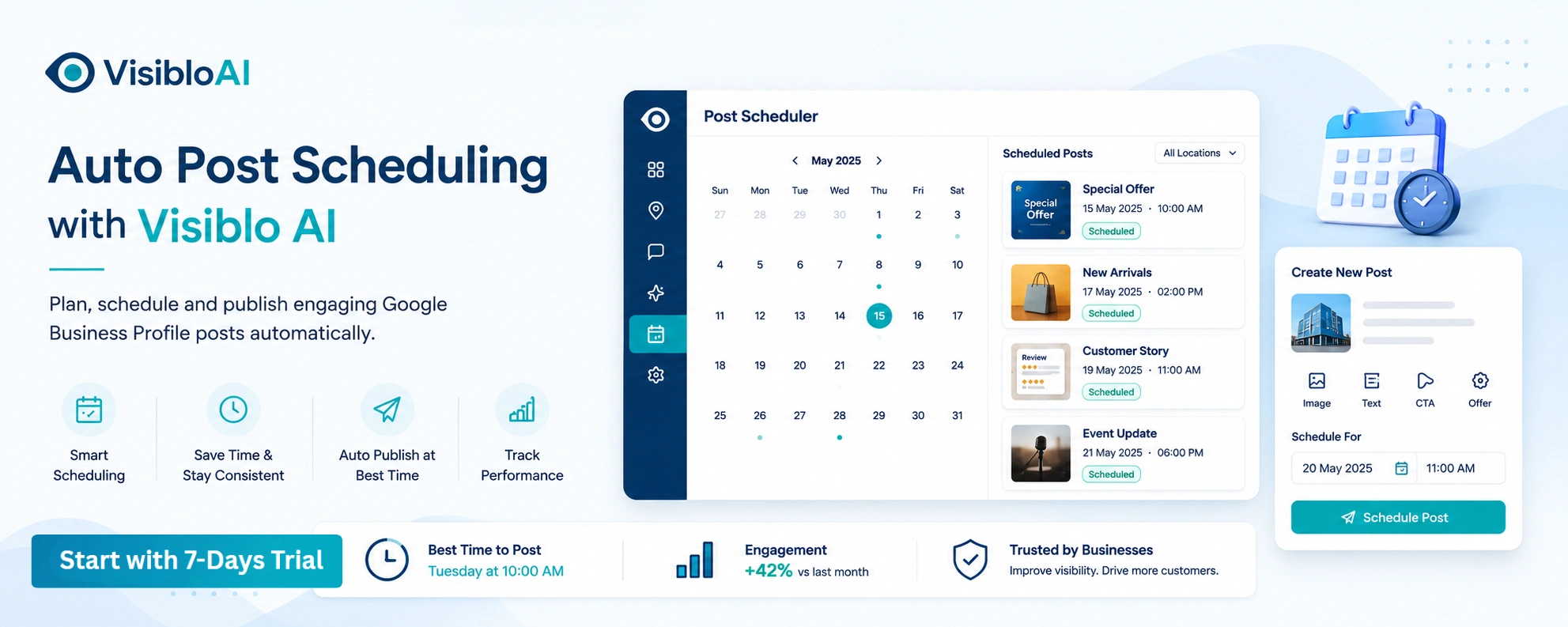
This is where tools such as Visiblo AI’s AI Auto Post Scheduling can help businesses plan, schedule and manage Google Business Profile content without manually publishing every post.
The important thing is to automate the process—not the thinking.
Each post should still have a clear purpose.
So, How Often Should You Post on Google Business Profile?
For most businesses, 1-2 useful Google Business Profile posts per week is the best place to start.
From there, adjust your frequency according to your business.
If you regularly have offers, events or important updates, increase your posting schedule.
If you only have one valuable thing to communicate each week, one strong post may be enough.
If you have nothing useful to say, do not publish filler content simply to reach a posting target.
The best Google Business Profile posting frequency is ultimately the one that helps you remain relevant, consistent and useful to potential customers without sacrificing content quality.
Start with a manageable schedule, measure what happens and improve from there.
Frequently Asked Questions
How often should you post on Google Business Profile?
For most local businesses, 1-2 posts per week is a practical starting point. Businesses with frequent offers, events or updates may post more often.
Is posting once a week on Google Business Profile enough?
Yes. For businesses with fewer updates, one useful weekly post may be enough. Quality and relevance matter more than filling a posting quota.
Should I post on Google Business Profile every day?
Usually not. Daily posting makes sense only when your business has enough genuinely useful information to share. Avoid creating repetitive posts simply to maintain daily activity.
How many Google Business Profile posts should I publish per month?
Many businesses can start with around 4 – 8 useful posts per month. Businesses with frequent promotions or events may need more.
Does posting more often improve Google Maps rankings?
There is no published Google rule saying that a specific posting frequency will improve rankings. Google says local results are mainly based on relevance, distance and prominence.
How long do Google Business Profile posts last?
Google currently says posts older than six months are archived unless a date range has been specified.
Do Google Business Profile posts expire after seven days?
The old seven-day rule is no longer the right basis for a current posting strategy. Google’s present documentation says posts older than six months are archived unless a date range is set.
Can you schedule Google Business Profile posts?
Yes. Google currently supports scheduling posts for future publication and recurring schedules such as weekly, monthly or custom recurrence.
Should every business location publish the same GBP posts?
Not necessarily. Multi-location businesses should keep content relevant to each location whenever offers, services, events or customer needs differ.
What matters more: posting frequency or consistency?
A sustainable schedule with useful content is generally more practical than publishing many posts for a short period and then becoming inactive. Start with a frequency you can maintain and adjust it using actual business activity and performance.